Tuesday, March 7, 2017

Multiples

Multiples

Project Description

Why would you need multiples of an object? Is more always better? Why would an object need to be replicated? Think about the following definitions:
Mold - a hollow container used to give shape to molten or hot liquid material(such as wax or               metal) when it cools and hardens.

Cast - an object made by shaping molten metal or similar material in a mold.

            Multiples - Having, relating to, or consisting of more than one individual, element, part, or                   other component.

Using mold making and casting techniques, you will you plaster or latex to make a mold from an object.


Using what you have learned to develop concepts, come up with conceptual reasoning for making multiples of your object. You do not need to make complete reproductions of your object, but at least 2 casts.

Specifications
Your sculpture must have at least 3 multiples. There is no limitation on amount, color, or dimensions.

Use all the skills you have learned through the year, and build on these. Challenge yourself to think outside of the box... literally. 

Evaluation
You will be graded on creativity, originality, and concept and craft. You will also be graded on your process (time-management, and working through multiple ideas). 

Please note: You will need to take photos through your entire process. These will be submitted along with the final project. No project will receive an A without this documentation. Process is important. 

Lastly, your project must have a title, and you must think of how it will be displayed. Presentation is part of context, and context drives meaning. 

Schedule
Homework- Due March 9th and 14th.

Your homework is to exercise the research and development stage of the creative process. You will do this by walking through the steps listed below. 


Here are the things you will need to bring to class on March 9th:

3 Objects
As I told you last class, you need to bring in 3 objects to see which you will make a mold from. The object must me no larger than 8”x8”x8” and non-porous(look it up).

For March 14th:
3 Detailed Drawings of your multiples
The drawings must be in your sketchbook using full pages(both sides when open) The drawing should show good use of the elements of design- line, form, color, texture, etc.  (Note: These are fully-resolved drawings, NOT sketches)

In addition, the drawings should be informative; they should give us helpful information. Please be sure your drawings answer the following questions:
1. How are the multiples physically organized? Show details.
2. How many multiples will be used? Be detailed and use color/texture/collage to show this.
3. What do these multiples communicate? Descriptions/diagrams in the drawings should address this.
4. What concept are you engaging? Again, descriptions/diagrams could be helpful.
5. How is the form of your multiples communicating? Scale, shape, text, etc.
6. What is the working title? This should be clearly labeled in your drawing.

Molds 100% complete
You must come prepared with all materials and tools to work. Mold must be 100% complete and ready to cast.

Read Essay by Hito Steyerl
https://document.li/M3IY
Answer Questions

https://goo.gl/forms/1cj0ojIH8tUJ9Ol03

Rubric for Homework
3 Objects = 25pts
3 Drawings = 25pts
Mold Complete = 25pts

Questions = 25pts--------------------------------
Total Possible  = 100pts

A =100 - 90

B = 89 - 80
C = 79 - 70
D = 69 - 60
F = 59 - 0 

Please be prepared at beginning of class with your own self-assessment based on the above rubric. 


Final Project Due Date


TBD- Project Due/Critique

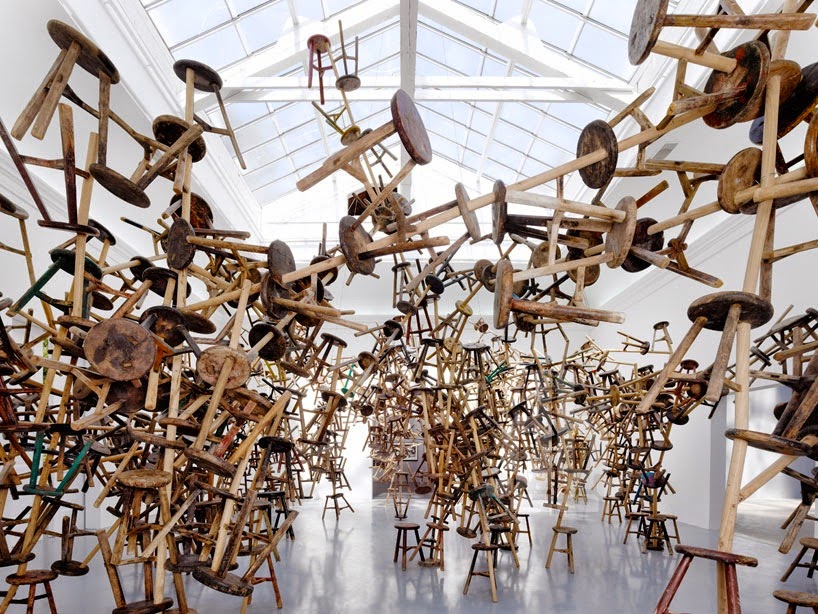
Ai Wei Wei


Chris Burden

Thursday, February 9, 2017

Site Specific Project


Site Specific Project

Using cardboard, glue and tape, you will construct a 3 dimensional object that occupies a specific space. This object must come in contact with at least 6 surfaces and will not fit in any other location. You will have 2 class sessions to work on this project, we will critique on February 28th.

Homework- Due February 21st

Your homework is to exercise the research and development stage of the creative process. You will do this by walking through the steps listed below. Here are the things you will need to bring to class on February 21st:

5 References w/descriptions
One-page typed document (printed out) with a list of 5 websites that you visited for your research. At least one of these websites must be an actual article (not a how-to, or list of pictures) that discusses some type of site specific sculpture. Examples of an appropriate article can be a newspaper story, something written for a journal/magazine, or something from Academia/industry). The one-page document must be printed out (no exceptions). It must include one-line brief descriptions for each website. This must be fully complete to receive credit for this portion.

3 Detailed Drawings of your sculpture
The drawings must be in your sketchbook using full pages(both sides when open) The drawing should show good use of the elements of design- line, form, color, texture, etc.  (Note: These are fully-resolved drawings, NOT sketches)

In addition, the drawings should be informative; they should give us helpful information. Please be sure your drawings answer the following questions:
1. How is your sculpture physically organized? Show details.
2. How will the viewer be engaged? Be detailed and use color/texture/collage to show this.
3. What formal qualities are you focusing on? Descriptions/diagrams in the drawings should address this. (positive/negative space, weight/tension, balance, representational/abstract)
4. What concept are you engaging? Again, descriptions/diagrams could be helpful.
5. How is the form of your sculpture communicating? Scale, shape, text, etc.
6. What is the working title? This should be clearly labeled in your drawing.
Materials and project 50% complete
You must come prepared with all materials and tools to work. Project must be at least 50% complete.

Read Chapter 1: 
GENEALOGY OF SITE SPECIFICITY


Rubric for Homework
5 References = 10pts
3 Drawings = 30pts
Reading and questions = 60pts
--------------------------------
Total Possible  = 100pts

A =100 - 90

B = 89 - 80
C = 79 - 70
D = 69 - 60
F = 59 - 0 

Please be prepared at beginning of class with your own self-assessment based on the above rubric. 


Final Project Due Date


February 28th - Project Due/Critique

Richard Serra

Ruben Ochoa

Valerie Hagarty

Robert Smithson Spiral Jetty

Monday, January 30, 2017

Additive Project

Additive Project

Each of you will be given a 24"x24" piece of Plywood. This project has been designed to let you come up with new ways of creating volume with a flat object. Each finished product must fit within a 24"x24"x24" cube and come in contact with all six sides. The focus of this project is volume and achieving 3 dimensionality from a limited amount of flat material. Critique is Thursday, February 9th.

Homework- Due February 2nd

Your homework is to exercise the research and development stage of the creative process. You will do this by walking through the steps listed below. Here are the things you will need to bring to class on February 2nd:

5 References w/descriptions
One-page typed document (printed out or emailed) with a list of 5 websites that you visited for your research. At least one of these websites must be an actual article (not a how-to, or list of pictures) that discusses some type of additive sculpture. Examples of an appropriate article can be a newspaper story, something written for a journal/magazine, or something from Academia/industry). The one-page document must be printed out (no exceptions). It must include one-line brief descriptions for each website. This must be fully complete to receive credit for this portion.
3 Detailed Drawings of your sculpture
The drawings must be in your sketchbook using full pages(both sides when open) The drawing should show good use of the elements of design- line, form, color, texture, etc.  (Note: These are fully-resolved drawings, NOT sketches)

In addition, the drawings should be informative; they should give us helpful information. Please be sure your drawings answer the following questions:
1. How is your sculpture physically organized? Show details.
2. How will the viewer be engaged? Be detailed and use color/texture/collage to show this.
3. What formal qualities are you focusing on? Descriptions/diagrams in the drawings should address this. (positive/negative space, weight/tension, balance, representational/abstract)
4. What concept are you engaging? Again, descriptions/diagrams could be helpful.
5. How is the form of your sculpture communicating? Scale, shape, text, etc.
6. What is the working title? This should be clearly labeled in your drawing.
Materials and project 50% complete
You must come prepared with all materials and tools to work. Project must be at least 50% complete.

Read as much as you can and look at the images. Answer the questions here: https://goo.gl/forms/Qt4loFBUVCzege1k1


Rubric for Homework
5 References = 10pts
3 Drawings = 30pts
Questions = 30pts
Materials/Project = 30pts
--------------------------------
Total Possible  = 100pts

A =100 - 90

B = 89 - 80
C = 79 - 70
D = 69 - 60
F = 59 - 0 

Please be prepared at beginning of class with your own self-assessment based on the above rubric. 


Final Project Due Date

February 9th- Project Due/Critique

Tom Friedman


Mark Di Suvero


Martin Puryear


Tony Cragg


Louise Nevelson


Richard Artschwager

Monday, January 23, 2017

Readymade

Readymade - Due January 26th 2017

Duchamp created the first ready-made, Bicycle Wheel (1913), which consisted of a wheel mounted on a stool, as a protest against the excessive importance attached to works of art. This work was technically a “ready-made assisted,” because the artist intervened by combining two objects. Duchamp subsequently made “pure ready-mades,” each of which consisted of a single item, such asBottle Rack (1914), and the best-known ready-made, the porcelain urinal entitled Fountain (1917). By selecting mass-produced, commonplace objects, Duchamp attempted to destroy the notion of the uniqueness of the art object. The result was a new, controversial definition of art as an intellectual rather than a material process.
Duchamp and his ready-mades were embraced by the artists who formed the nihilistic Dada movement from 1916 to the 1920s; Duchamp became Dada’s main proponent in the United States. The ready-made continued to be an influential concept in Western art for much of the 20th century. It provided a major basis for the Pop art movement of the 1950s and ’60s, which took as its subject matter commonplace objects from popular culture. The intellectual emphasis of ready-mades also influenced the conceptual art movement that emerged in the 1960s, which considers the artist’s idea more important than the final product.
You will bring in an object changing its context from a mass produced everyday object into a art piece. Using methods such as adding a title that changes the way we think about the object or creating a new way of displaying are acceptable ways of elevating an object into art. 
In addition to bringing in your object, please read this essay: https://document.li/6Cj9/ and answer these questions: https://goo.gl/forms/ZhWcTFxW3rG3RtD13
Marcel Duchamp Fountain 1917

Thursday, December 8, 2016

Activated Sculpture – FINAL PROJECT

Activated Sculpture – FINAL PROJECT
Project Description
The Activated Sculpture is incomplete without the presence of viewer. This viewer completes the sculpture, the sculpture looks to be missing something without the viewer. The activation can be physical, theoretical and/or conceptual but must be recognizable.

Documenting your process is hugely important. These projects may not be able to be viewed at juries so it is important to show your thoughts and experiments as well as document the final product.

*Consider how your sculpture can interact with others.
*Look for objects in your everyday life that you can use as source material. You don't have to make everything. Some things can be modifications of existing things you already own (or find).
*Concept is most important

Specifications
Your sculpture can be any size. There is no limitation on materials, but it must be safe (no dangerous electricity, fire, sharp objects, etc).

Your sculpture may hang, rest on floor, or be placed on the wall.

It must be completed by a viewer.

Find materials from the world around you. Be resourceful- there are free materials everywhere. 

Use all the skills you have learned through the year, and build on these. Challenge yourself to think outside of the box... literally. 

Evaluation
You will be graded on creativity, originality, and concept and craft. You will also be graded on your process (time-management, and working through multiple ideas). 

Please note: You will need to take photos through your entire process. These will be submitted along with the final project. No project will receive an A without this documentation. Process is important. 

Lastly, your project must have a title, and you must think of how it will be displayed. Presentation is part of context, and context drives meaning. 

Schedule
Homework- Due December 15th

Your homework is to exercise the research and development stage of the creative process. You will do this by walking through the steps listed below. Here are the things you will need to bring to class on May 3rd:

5 References w/descriptions
One-page typed document (printed out) with a list of 5 websites that you visited for your research. At least one of these websites must be an actual article (not a how-to, or list of pictures) that discusses some type of activated sculpture. Examples of an appropriate article can be a newspaper story, something written for a journal/magazine, or something from Academia/industry). The one-page document must be printed out (no exceptions). It must include one-line brief descriptions for each website. This must be fully complete to receive credit for this portion.

3 Detailed Drawings of your sculpture
The drawings must be in your sketchbook using full pages(both sides when open) The drawing should show good use of the elements of design- line, form, color, texture, etc.  (Note: These are fully-resolved drawings, NOT sketches)

In addition, the drawings should be informative; they should give us helpful information. Please be sure your drawings answer the following questions:
1. How is your sculpture physically organized? Show details.
2. How will the viewer be engaged? Be detailed and use color/texture/collage to show this.
3. What does the viewer complete? Descriptions/diagrams in the drawings should address this.
4. What concept are you engaging? Again, descriptions/diagrams could be helpful.
5. How is the form of your sculpture communicating? Scale, shape, text, etc.
6. What is the working title? This should be clearly labeled in your drawing.
Materials and project 50% complete
You must come prepared with all materials and tools to work. Project must be at least 50% complete.


Rubric for Homework
5 References = 10pts
3 Drawings = 30pts
Materials/Project = 60pts
--------------------------------
Total Possible  = 100pts

A =100 - 90

B = 89 - 80
C = 79 - 70
D = 69 - 60
F = 59 - 0 

Please be prepared at beginning of class with your own self-assessment based on the above rubric. 


Final Project Due Date

January 10th- Project Due/Critique

Robert Morris


Miranda July