Tuesday, April 12, 2016

Weighted Mobile

Weighted Mobile
Project Description
We have worked on the floor, table, pedestal, and wall but now it is time to occupy a space in the middle of the room. Hanging sculptures look to be floating, only suspended by thin, unobtrusive support. Each sculpture will use a counter weight in the form of anything you like up to 10 lbs. This counter weight will give your piece mass while enabling you to work on the delicate process of balance.

Hanging Mobiles are free to move and are a great introduction to kinetic sculpture and well as exploring a more formal approach to making sculpture. Answer the following questions, as you prepare to research for your design:

1. Is my piece balanced?
2. Does my piece have tension?
3. Am I occupying volume?
4. Does it work when viewed from all sides(top, bottom, and all the way around since it is hanging in space)?

Documenting your process is hugely important. These projects may not be able to be viewed at juries so it is important to show your thoughts and experiments as well as document the final product.

Optional: Consider how your sculpture can have moving parts, and how it will function. Look for objects in your everyday life that you can use as source material. You don't have to make everything. Some things can be modifications of existing things you already own (or find).

Specifications
Your sculpture must be smaller than 24"x24"x24". There is no limitation on materials, but it must be safe (no dangerous electricity, fire, sharp objects, etc).

Your sculpture must hang from a single point in the room.

It must contain at least 6 hanging elements and the counter weight.

Find materials from the world around you. Be resourceful- there are free materials everywhere. 

Use all the skills you have learned through the year, and build on these. Challenge yourself to think outside of the box... literally. 

Evaluation
You will be graded on creativity, originality, and concept and craft. You will also be graded on your process (time-management, and working through multiple ideas). 

Please note: You will need to take photos through your entire process. These will be submitted along with the final project. No project will receive an A without this documentation. Process is important. 

Lastly, your project must have a title, and you must think of how it will be displayed. Presentation is part of context, and context drives meaning. 

Schedule
Homework- Due April 19th

Your homework is to exercise the research and development stage of the creative process. You will do this by walking through the steps listed below. Here are the things you will need to bring to class on Jan 29th:

5 References w/descriptions
One-page typed document (printed out) with a list of 5 websites that you visited for your trap research. At least one of these websites must be an actual article (not a how-to, or list of pictures) that discusses some type of mobile or hanging sculpture. Examples of an appropriate article can be a newspaper story, something written for a journal/magazine, or something from Academia/industry). The one-page document must be printed out (no exceptions). It must include one-line brief descriptions for each website. This must be fully complete to receive credit for this portion.

3 Detailed Drawings of your multiples
The drawings must be in your sketchbook using full pages(both sides when open) The drawing should show good use of the elements of design- line, form, color, texture, etc.  (Note: These are fully-resolved drawings, NOT sketches)

In addition, the drawings should be informative; they should give us helpful information. Please be sure your drawings answer the following questions:
1. How is your mobile physically organized? Show details.
2. How many elements will be used? Be detailed and use color/texture/collage to show this.
3. What do these elements communicate? Descriptions/diagrams in the drawings should address this.
4. What concept are you engaging? Again, descriptions/diagrams could be helpful.
5. How is the form of your elements communicating? Scale, shape, text, etc.
6. What is the working title? This should be clearly labeled in your drawing.
Materials and project 50% complete
You must come prepared with all materials and tools to work. Project must be at least 50% complete.


Rubric for Homework
5 References = 10pts
3 Drawings = 30pts
Materials/Project = 60pts
--------------------------------
Total Possible  = 100pts

A =100 - 90

B = 89 - 80
C = 79 - 70
D = 69 - 60
F = 59 - 0 

Please be prepared at beginning of class with your own self-assessment based on the above rubric. 


Final Project Due Date

April 26th- Project Due/Critique
 
 Alexander Calder
 Aaron Curry


Jean Tinguely

Monday, March 7, 2016

Multiples

Project Description

Why would you need multiples of an object? Is more always better? Why would an object need to be replicated? Think about the following definitions:
Mold - a hollow container used to give shape to molten or hot liquid material(such as wax or               metal) when it cools and hardens.

Cast - an object made by shaping molten metal or similar material in a mold.

            Multiples - Having, relating to, or consisting of more than one individual, element, part, or                   other component.

Using mold making and casting techniques, you will you plaster or latex to make a mold from an object.


Using what you have learned to develop concepts, come up with conceptual reasoning for making multiples of your object. You do not need to make complete reproductions of your object, but at least 2 casts.

Specifications
Your sculpture must have at least 3 multiples. There is no limitation on amount, color, or dimensions.

Use all the skills you have learned through the year, and build on these. Challenge yourself to think outside of the box... literally. 

Evaluation
You will be graded on creativity, originality, and concept and craft. You will also be graded on your process (time-management, and working through multiple ideas). 

Please note: You will need to take photos through your entire process. These will be submitted along with the final project. No project will receive an A without this documentation. Process is important. 

Lastly, your project must have a title, and you must think of how it will be displayed. Presentation is part of context, and context drives meaning. 

Schedule
Homework- Due March 8th and 10th.

Your homework is to exercise the research and development stage of the creative process. You will do this by walking through the steps listed below. Here are the things you will need to bring to class on March 8th:

3 Objects
As I told you last class, you need to bring in 3 objects to see which you will make a mold from. The object must me no larger than 8”x8”x8” and non-porous(look it up).

For March 10th:
3 Detailed Drawings of your multiples
The drawings must be in your sketchbook using full pages(both sides when open) The drawing should show good use of the elements of design- line, form, color, texture, etc.  (Note: These are fully-resolved drawings, NOT sketches)

In addition, the drawings should be informative; they should give us helpful information. Please be sure your drawings answer the following questions:
1. How are the multiples physically organized? Show details.
2. How many multiples will be used? Be detailed and use color/texture/collage to show this.
3. What do these multiples communicate? Descriptions/diagrams in the drawings should address this.
4. What concept are you engaging? Again, descriptions/diagrams could be helpful.
5. How is the form of your multiples communicating? Scale, shape, text, etc.
6. What is the working title? This should be clearly labeled in your drawing.

Molds 100% complete
You must come prepared with all materials and tools to work. Mold must be 100% complete and ready to cast.

Rubric for Homework
3 Objects = 25pts
3 Drawings = 25pts
Mold Complete = 50pts
--------------------------------
Total Possible  = 100pts

A =100 - 90

B = 89 - 80
C = 79 - 70
D = 69 - 60
F = 59 - 0 

Please be prepared at beginning of class with your own self-assessment based on the above rubric. 


Final Project Due Date


April 5th- Project Due/Critique

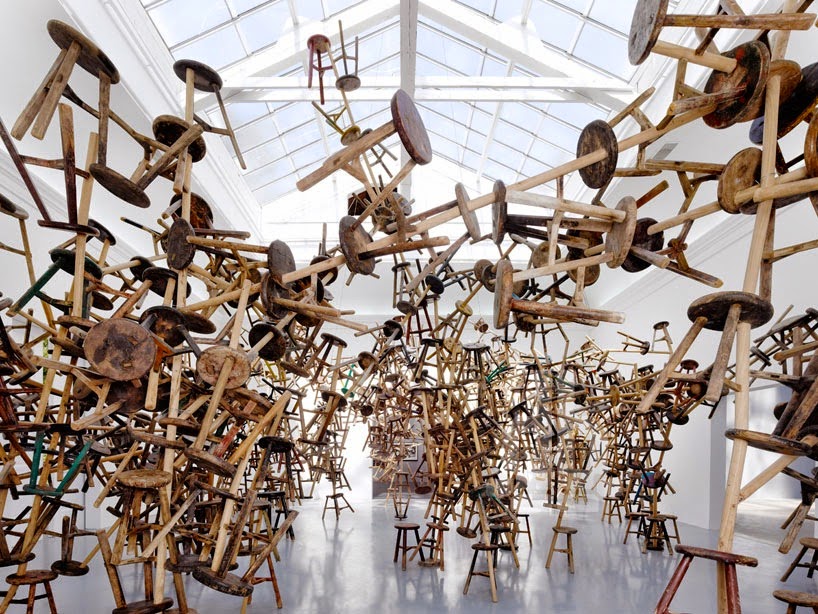
Ai Wei Wei


Chris Burden

Tuesday, January 26, 2016

Syllabus

NWSA: 3D Studio 
New World School of The Arts 
Art 1201C2 Section 1 Spring 2016
Tuesday and Thursday 1:10pm -3:45 pm
Instructor: Mr. Long
Room: 5102
Email: long.nwsa@gmail.com
Class Blog: nwsasculpture10.blogspot.com


This is a “Hands On” Studio course with an introduction to the world of Kinetic, Experiential, and Performative Sculpture. We will discuss in depth the history of these mediums and develop the technical skills to explore them ourselves. Using found and new materials, the projects will reflect upon history, theory and personal creativity. Additional readings will be posted to the blog as well as adjustments to the class schedule. 

CLASS RESPONSIBILITIES AFFECTING YOUR GRADE:
*participation in class discussions, extracurricular assignments and in critiques of fellow students’ projects
*completing all assignments on time, including any writing assignments
*acquiring editing skills
*approximately half of your grade is determined by your mid semester paper and end of the semester project.

EVALUATION:
Evaluation is based on technical ability, creative content, progressive development, and the degree on which you challenge yourself.
90-100 A – outstanding: work, participation, effort and, attitude remarkable 
80-89 B – good: work, participation, effort and, attitude beyond expectation 
70-79 C - average:all work completed 
60-69 D – poor: any one of the requirements below expectation 
59-below F – failing: work incomplete, effort and/or, attitude inadequate


SKETCHBOOK:
Maintain a sketchbook that contains all of your research, sketches, ideas and inspirations. Document all your brain storms, questions, etc. Bring this journal to every class. This will serve as documentation of your thought process, and will be reviewed by the instructors.!

CLASS AND SHOP RULES:
Cell phones and other electronic devices are limited to PRODUCTIVE uses. Productive uses include listening to music, researching artists and materials, and taking notes. Internet usage must be limited to class- related research (no checking email, social networking sites, etc). Continued use, after a warning, will result in disciplinary action. 
• Food and Drink are not allowed in the wood shop.  • Spray paint, resin and mount adhesives must be used in the loading dock. • All materials and projects will be stored on 10th grade shelves. Anything left out will be discarded.  • Studio time ends promptly at 3:30pm. The final 15 mins of class will be used for clean up. 

ADDITIONAL SHOP ACCESS:
Our classroom consists of two rooms- the wood shop and plaster area. Students may do work outside of class-time in the plaster room, as long as there is no class in session or by obtaining permission from the instructor teaching at the time you wish to work. No one is permitted in the wood shop without instructor supervision. A lab computer is accessible during class hours; however files saved on the computer are not secure- plan accordingly. Access to certain shop equipment requires that you pass a safety orientation. 

ATTENDANCE:
Attendance is required during the days and hours that the school is in session. Students are expected to: attend class as scheduled; arrive at class on time: and demonstrate appropriate behavior and a readiness to learn. Students are responsible for catching up and getting any assignments notes and readings missed because absence.
-Class attendance - Students are to be counted in attendance if they are physically present in class for at least half of the class period, have been excused by the teacher on class-related assignment, or have been requested by a member of the school support staff for an approved school activity.
-Tardiness - A student is considered tardy if he/she is not present at the moment the school bell rings for the class assigned. -Early Sign-outs – No student shall be released within the final 30 minutes of the school day unless authorized by the school principal or principal’s designee, e.g., emergency, sickness.
Source; Miami-Dade curriculum Bulletin 2012-14, page 26.

HONOR CODE:
Students are expected to follow the honor Code of the New World School of The Arts. All assignments must be original and completed independently during the quarter.


CRITIQUES:
You are expected to be an enthusiastic participant in this class and take ownership of your work and development as a creative professional. The function of critiques is not only to receive feedback on your work, but to build essential skills of presentation, negotiation, and persuasion. 
Projects must be ready for peer review BEFORE class or critique begins, unless otherwise specified. Craftsmanship and presentation greatly affect your grade.

DISABILITIES:
Reasonable accommodations will be made for students with documented disabilities. Please contact the instructor to work out the details for any accommodations. 

DISCLAIMER:
This syllabus is subject to change at any time during the quarter. You will be notified of any changes or will be issued a new syllabus.

PROJECTS:

Ready made display - Find an object that has already been made and create a new way of displaying this object which elevates it to become art.

Additive Volume - Each student will be given a 24"x24" piece of plywood and they must create a 3 dimensional object that occupies the volume of an invisible 24"x24" cube touching all 6 sides. 

Mold Making - Using Plaster and Latex mold making techniques, you will make a mold from a readymade object and make multiples of it. Be prepared to defend why there needs to be the number of multiples you have made.

Site Specific - Using only cardboard and masking tape, you will chose a spot in the class room to create a site specific piece. One that will not work anywhere but the place you have chosen.

Weighted Mobile - Each student will be given a concrete block. A hanging mobile will be created with at least 6 elements using the block as a counter weight.

Activated Sculpture - Create a sculpture that needs a human presence to activate it.